Eleanor Hughes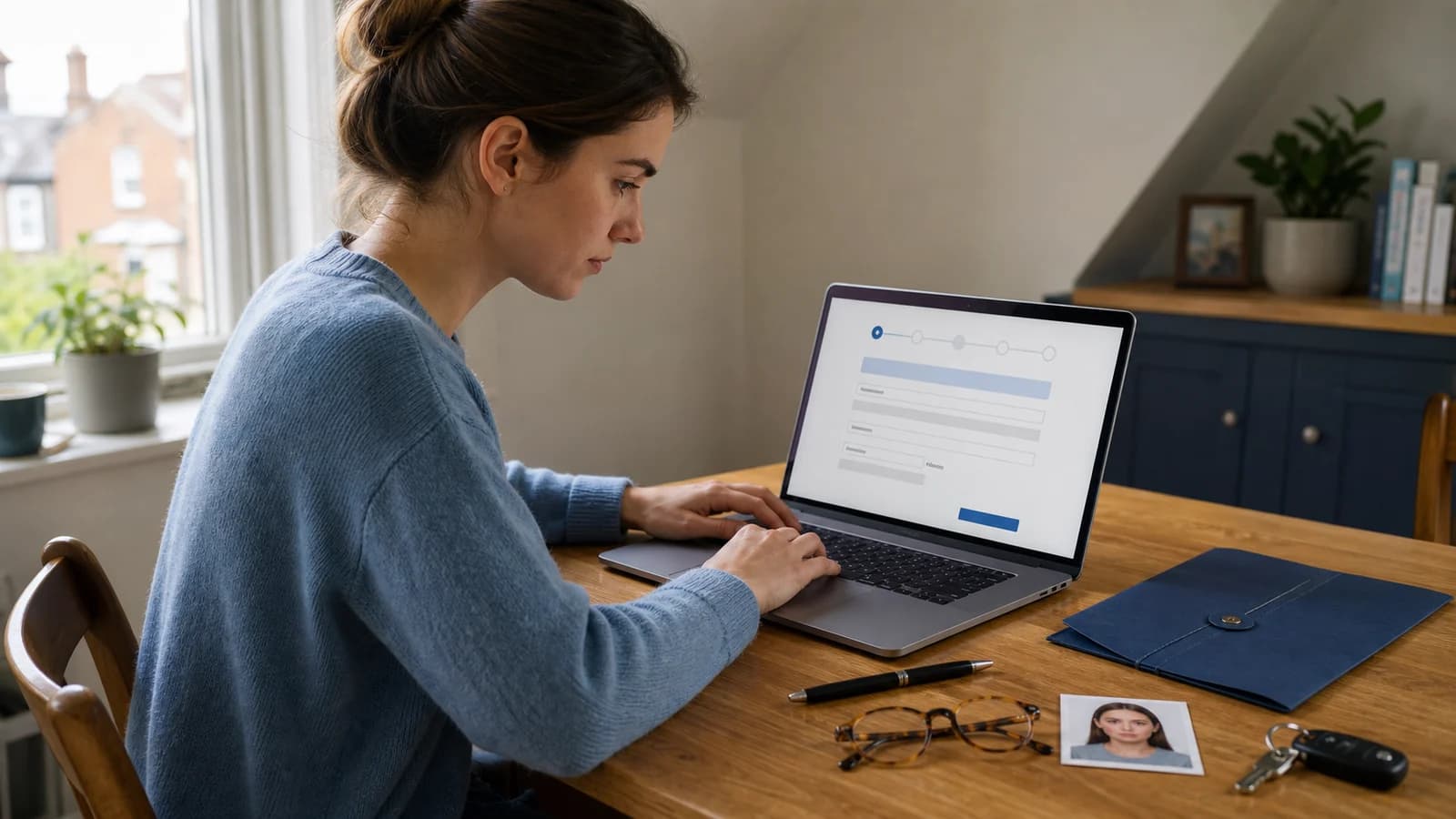
Last verified 3 August 2026 against the official pages linked below.
A first provisional driving licence costs £34 when you apply online, £43 if you apply by post, and you can apply from 15 years and 9 months old. Apply online and your licence should arrive within one week. That is the whole headline: one form, one card payment, one week. What trips people up is everything around the form, when you are actually allowed to apply, what counts as proof of identity if you do not have a passport, and how to line the application up with your 17th birthday so you are not sitting on your hands waiting for a photocard when you could already be booking a theory test. This guide walks through the real application, step by step, with a worked countdown you can copy for your own birthday.
When can you apply, and what does each age actually unlock?
You can apply from the day you turn 15 years and 9 months old, and that is one year and three months before your 17th birthday, not three months before, which is where most people miscalculate. The odd-looking age exists so the licence can be in your hands for the things that unlock at 16 and 17. Applying early costs nothing extra and commits you to nothing; the licence simply sits ready until each threshold arrives.
| Age | What it unlocks |
| 15 years, 9 months | Apply for your provisional licence: £34 online |
| 16 | Ride a moped, once you have done compulsory basic training (CBT) |
| 17 | Car lessons, supervised private practice, and your car theory test |
| After passing theory | Book the practical driving test |
The moped line surprises people: GOV.UK's licence categories table puts the minimum age for category AM mopeds at 16, so a provisional obtained at 15 years and 9 months starts earning its keep within three months. For cars, the rule is equally clean: you can take the theory test from your 17th birthday onwards, and lessons and private practice start at 17 too. One piece of admin worth getting straight now: the licence comes from the DVLA, but your theory and practical tests are run by the DVSA, two different agencies with two different jobs, and knowing which is which saves you emailing the wrong one later. Northern Ireland runs its own separate licensing system through the DVA, so everything below applies to England, Scotland and Wales.
What do you need to qualify?
There are exactly three eligibility rules: be at least 15 years and 9 months old, be able to read a number plate from 20 metres away, and have lived in Great Britain for at least 185 days. That is the entire bar. There is no requirement to have booked lessons, no minimum school grade, no parental income check. The eyesight standard is the only thing you can meaningfully "fail".
Take the 20-metre standard seriously, because it follows you all the way to test day. Twenty metres is roughly five car lengths: pace it out on your street and read a parked car's plate from there. Glasses or contact lenses are fine, as long as you actually wear them when you drive. If the plate is a blur at 20 metres, book an optician's appointment before you spend £34, not after.
What does the online application actually ask for?
The application runs through a GOV.UK sign-in: you create sign-in details if you do not already have them, and the service tells you at sign-in whether you need to prove your identity: proof "usually involves using photo ID like a passport". If you hold a UK passport, that is the smooth path: you give your 9-digit passport number so the DVLA can confirm who you are. You do not send the passport itself, and there is nothing to print or post. Payment is by MasterCard, Visa, Electron or Delta debit or credit card. Realistically, a 16-year-old with a passport and a card to hand finishes the form in one sitting.
No UK passport? You still have two routes. If you have a UK Visas and Immigration (UKVI) account, you can generate a share code and prove your identity without sending anything physical. Otherwise you apply by post (£43, paid by cheque or postal order), and send one of the accepted identity documents: a current, valid foreign passport (non-EU/EEA) with a visa sticker or stamp; a current, valid Irish passport; a travel document; a UK birth, adoption or naturalisation certificate with supporting evidence; or evidence that you receive a state pension. One rule the DVLA does not bend on: originals only. Photocopies, laminated certificates and certified copies, including copies certified at the Post Office, are all rejected.
How long does the licence take to arrive?
"Your licence should arrive within one week if you apply online. It may take longer if DVLA need to make additional checks." Postal applications take longer still, not least because your identity documents make the round trip by post too. So the online route wins on every axis: £9 cheaper, days faster, and your birth certificate never leaves the house.
The arrival date matters more than it looks, because the provisional is the key that opens the next door: you must have a provisional driving licence to book your theory test. No licence number, no booking, which is why the worst time to apply is the week you want your first lesson. Build in slack: apply a month or more before you plan to use it, and the one-week delivery window becomes irrelevant.
A worked countdown: turning 17 on 1 December 2026
Take a learner whose 17th birthday falls on 1 December 2026, so they were born on 1 December 2009. Their earliest application date is 1 September 2025: fifteen years plus nine months, landing one year and three months before the birthday. Here is the full countdown, with the decision points marked.
| Date | Milestone | What to do |
| 1 September 2025 | Turns 15 years, 9 months | Earliest day to apply (£34 online, licence should arrive within a week |
| 1 December 2025 | 16th birthday | Moped riding unlocks, after CBT) the provisional needs to be in hand first |
| Mid-November 2026 | Two-plus weeks before turning 17 | Last sensible window to apply if they have not already; once the licence arrives, book a theory slot for on or after 1 December |
| 1 December 2026 | 17th birthday | First car lesson, supervised private practice, and the earliest possible theory test date |
| From the theory pass | Certificate in hand | Book the practical test, and start early, because waiting times vary hugely by centre |
Two things to notice. First, the window is generous: this learner has fifteen months between "allowed to apply" and "allowed to drive a car", so there is no excuse for the licence being the bottleneck. Second, the theory pass has a shelf life, the certificate lasts two years, so the ideal sequence is to pass theory shortly after turning 17 and use the momentum, not to pass at 17 and let the certificate quietly expire at 19.
What should you do in your first week with the licence?
Book your theory test for on or after your 17th birthday
The theory test costs £23 and your test date cannot fall before your 17th birthday, but there is nothing stopping you locking in a date just after it. The test itself is 50 multiple-choice questions in 57 minutes with a pass mark of 43, plus a hazard perception section needing 44 out of 75, both parts in one sitting. Learners who book a real date revise; learners who "will book it soon" mostly do not, so put the appointment in the calendar first and let the deadline do the motivating. A few weeks of structured revision is plenty if you use it. Our theory test tips cover how to spend that time.
Set up private practice properly
Private practice is where cheap, plentiful driving hours come from, but the supervision rules are strict: your supervisor must be over 21, qualified in the type of vehicle you are learning in, and have held their full licence for 3 years, and they cannot be paid unless they are an approved instructor. It is illegal for them to use a mobile phone while supervising you, and you also need insurance cover on the car you practise in; some insurers require the supervisor to be over 25. Get it wrong and the penalties land on your licence: a fine of up to £1,000 and up to 6 penalty points for driving without the right supervision. Those points are not a slap on the wrist. Points collected as a learner feed straight into the six-point rule that can revoke a new driver's licence. The full breakdown is in our guide to supervising a learner driver. One firm boundary: motorway practice with family or friends is illegal. learners can only drive on motorways with an approved driving instructor in a dual-control car, in England, Scotland or Wales.
Start revising immediately: your age is an advantage with an expiry date
Our analysis of the DVSA's results tables published on 25 June 2026 shows that in 2024/25, the latest year with an age breakdown, 17-year-olds passed the theory test at 50.0%, the best of any age band. The overall GB pass rate in 2025/26 was just 44.8%. Read that gap plainly: candidates who sit the test young, while full-time-education revision habits are still warm, do measurably better than the average candidate. If you have just received your provisional at 16, you are approaching the test at the age with the strongest recorded pass rate. Waiting does not make the test easier; it makes you older.
And you do not need to wait for the photocard to start. Everything the theory test examines is public, and Drivings gives you free mock theory exams that mirror the real 50-question, 57-minute format and pass mark, plus a structured theory test course that works through every topic the DVSA can ask about. A learner who applies at 15 years and 9 months and does two mocks a week arrives at their 17th birthday with the 43/50 pass mark well within reach, and at £23 per sitting, passing first time is the cheapest way through.
Your provisional licence questions, answered
Can I drive a car at 16?
No: car driving starts at 17, whether that is lessons or supervised private practice. What a 16-year-old can do with a provisional is ride a moped, since the minimum age for category AM is 16, after completing CBT. The one theory-test exception: you can take the theory test from your 16th birthday if you get, or have applied for, the higher weekly rate of the mobility part of Personal Independence Payment (PIP).
What if I don't have a passport?
You can still apply. With a UK Visas and Immigration (UKVI) account, you generate a share code and prove your identity online without sending documents. Otherwise, apply by post with one accepted original document, such as a current, valid Irish passport, a non-EU/EEA foreign passport with a visa sticker or stamp, a travel document, or a UK birth, adoption or naturalisation certificate with supporting evidence. Originals only; no photocopies or certified copies.
How long does it take to get a provisional licence?
Within one week, if you apply online: the DVLA says it may take longer if additional checks are needed. Postal applications take longer because the form and your identity documents travel by post.
Can I use a provisional licence as photo ID?
Yes. GOV.UK's accepted photo ID list for voting explicitly includes "a UK or Northern Ireland photocard driving licence (full or provisional)", and the photocard is routinely accepted as proof of age and identity day to day. For many 16-year-olds it is their first government-issued photo ID, a genuinely useful side benefit of applying early.
Does a provisional licence expire?
The photocard is valid for 10 years, so a provisional issued at 15 years and 9 months carries you well past any realistic learning timeline. Renewal, if you ever need it, costs £14 online or £17 by post.
Can I book my theory test before I turn 17?
Your test date cannot fall before your 17th birthday, the theory test can be taken from your 17th birthday onwards, and you need your provisional licence to make any booking at all. The practical upshot: get the licence early, then book a slot for just after the birthday, exactly as in the countdown table above.
Do I need professional lessons before private practice?
There is no legal minimum number of professional lessons before practising with family or friends, the law regulates the supervisor and the insurance, not your lesson count. Most learners still combine both, because an instructor's dual controls and structured syllabus cover things a parent's hatchback cannot.
What about Northern Ireland?
Northern Ireland has a separate licensing system run by the DVA rather than the DVLA, with its own application process and its own learner rules. The GOV.UK service in this guide covers Great Britain only.