Theo Bennett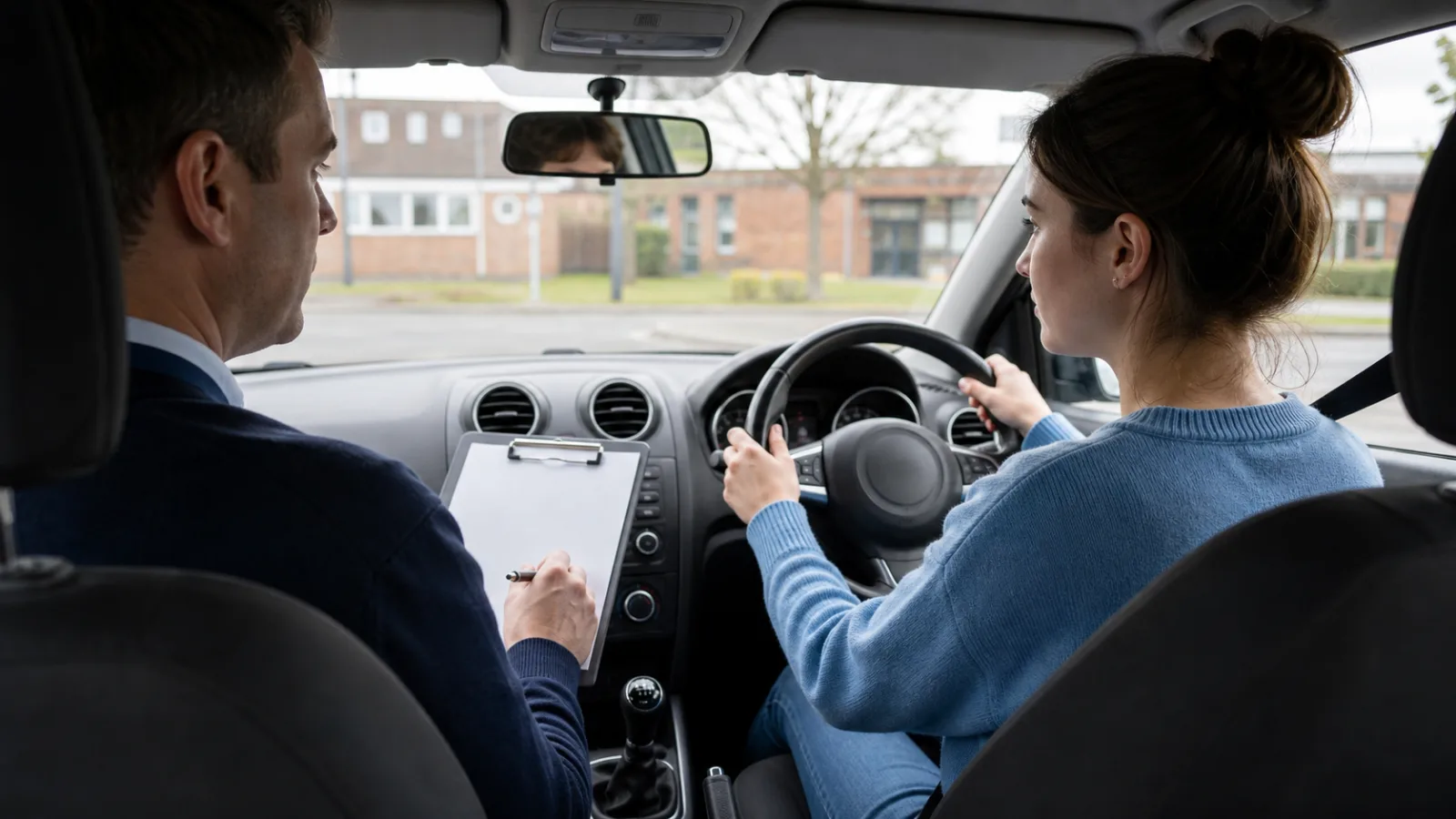
Last verified 3 August 2026 against the GOV.UK pages linked below. DVSA statistics are from the official June 2026 release.
The UK driving test runs in a fixed order: an eyesight check, one 'tell me' vehicle safety question, then around 35 minutes of driving that includes a 20-to-35-minute independent driving section, one reversing exercise and a 'show me' question answered on the move, and you get your result before you leave the test centre. To pass, you need 15 or fewer driving faults and no serious or dangerous faults.
Exactly half of candidates now manage it: the GB car pass rate reached 50.0% in 2025/26, the highest in the recorded series (DVSA data, published June 2026, full tables further down). This guide walks through every part of the test in the order it happens, with the timings, the marking rules, and the myths answered straight.
What do you need to bring, and what happens when you arrive?
You need your provisional licence and a car that meets DVSA's requirements, usually your instructor's tuition car, but your own is fine if it qualifies; our guide to using your own car for the driving test covers the checklist. Before the test starts, the examiner will ask whether you want someone to sit in the back of the car during the drive, and whether you want them present for the result and feedback afterwards. That's usually your driving instructor, but a relative or friend is allowed too.
The eyesight check comes first, and it can end the test
Before any driving, you must read a number plate from 20 metres away. 20.5 metres if it's an old-style plate. Fail it and there is no second act: GOV.UK is blunt that you'll fail the driving test and the test will end. Twenty metres is roughly five car lengths, so check yourself against a parked car's plate in the days before, and wear your glasses or contact lenses on the day if you need them.
What are the 'tell me' and 'show me' questions?
You'll answer two vehicle safety questions: a 'tell me' question before you set off, where you explain how you'd carry out a safety check, and a 'show me' question later in the test, where you demonstrate one while you're driving. The 'show me' question doubles as a quiet test of multitasking: the examiner wants to see you operate a control without your driving wobbling.
What happens during the 35 minutes of driving?
You'll drive for around 35 minutes (about 65 minutes if you're taking the extended test after a disqualification). Whenever you're not in the independent driving section, the examiner gives you turn-by-turn directions, and they'll ask you clearly when it's time for each exercise. There are no motorways in the test. Somewhere within the drive you'll do the one reversing exercise and answer the 'show me' question, neither is announced in advance, so treat the whole 35 minutes as live.
How does independent driving work?
For 20 to 35 minutes of the test you drive without step-by-step prompts, following a sat nav, traffic signs, or a combination of both, the examiner tells you which and sets the sat nav up. If a sign is obscured, the examiner will give you directions until you can see the next one. And here is the fact that defuses most sat-nav anxiety, straight from GOV.UK: "The examiner will not give you a fault for taking a wrong turning". They'll help you get back on route. Independent driving tests decision-making, not navigation.
Which reversing exercise will you get?
You'll do one reversing exercise, and it will be one of three: parallel parking at the side of the road; parking in a bay, either driving in and reversing out or reversing in and driving out; or pulling up on the right-hand side of the road, reversing for around two car lengths and rejoining the traffic. You don't get to pick, so practise all three until none of them feels like the bad draw.
How long does each part of the test take?
Only two parts have published durations, the drive and the independent section within it, but the running order never changes. Here's the whole appointment, in sequence.
| Part | What happens | How long |
| Eyesight check | Read a number plate from 20 metres (20.5 m old-style) | Moments, before you get in the car |
| 'Tell me' question | One vehicle safety question, answered before you drive | Before you move off |
| The drive | General driving with examiner directions | Around 35 minutes |
| Independent driving | Follow a sat nav, traffic signs or both, unprompted | 20 to 35 minutes, inside the drive |
| Reversing exercise | One of: parallel park, bay park, pull up on the right | During the drive |
| 'Show me' question | One safety question answered on the move | During the drive |
| Result and feedback | Verbal result and fault explanation, plus email | Straight after you park |
How is the test marked?
You pass with 15 or fewer driving faults and no serious or dangerous faults. Everything the examiner records lands in one of three categories, defined by DVSA like this:
A dangerous fault involves actual danger to you, the examiner, the public or property. A serious fault is something that has the potential to be dangerous. A driving fault is not potentially dangerous, but if you keep making the same fault, it could become a serious fault.
A worked example shows how the arithmetic actually falls. Candidate one collects 14 driving faults across the drive (late mirror checks before changing direction, hesitant progress at roundabouts), but nothing serious or dangerous: that's a pass, at 14 of the 15 allowed. Candidate two drives far more tidily and picks up only 4 driving faults, but emerges from one junction without making effective observations. A serious fault, and currently the number one reason for failing on DVSA's list: that's a fail, and the low fault count doesn't matter. The next two most common fail reasons follow the same theme, not using mirrors correctly when changing direction, and not moving off safely. Observation, not manoeuvring, is what ends most tests; our deep dive on driving test faults unpacks every category on the examiner's marking sheet.
What are your real chances of passing?
Better than they've ever been in the modern record, but still a coin flip. In 2025/26, Great Britain ran 1,998,621 car practical tests and passed 1,000,043 of them: a 50.0% pass rate, the highest in the DVSA series going back to 2007/08, up from 48.7% the year before and well clear of the series low of 44.2% (DVSA data, published June 2026. The full year-by-year and centre-by-centre tables are on our practical test pass rates page). DVSA's own Ready to Pass campaign still puts it the sober way round: "48 out of every 100 driving tests were failed in Great Britain during June 2026".
Where you take the test moves the odds dramatically. Among centres with at least 1,000 tests in 2025/26, Wolverhampton passed just 34.3% of candidates, with Wednesbury (35.0%) and Barking, Tanner Street (36.3%) close behind, while Melton Mowbray passed 69.7%, Barrow-in-Furness 69.6% and Dorchester 69.0%. That's a doubled pass rate depending on postcode, which is worth knowing when you're browsing test centres near you.
How do you get your result, and how does booking work?
The examiner tells you the result verbally at the end of the test, talks you through any faults, and you also get it by email, and if you asked for someone in the back seat, they can listen to the feedback with you. There's no waiting period and no appeal-by-hope: the decision is made in the car.
On the practical side of the diary: the car test costs £62 to £75 (GOV.UK publishes the range), you can book up to 24 weeks ahead, and the booking service is open 6am to 11:40pm. If your date stops suiting you, DVSA lets you reschedule free with at least 10 working days' notice: worth diarising, because less notice means the fee is spent. Slots vary hugely by centre, so check current driving test waiting times before you commit. And remember the clock behind all of it: your theory test pass certificate lasts 2 years, so the practical has to happen inside that window or you're back to the theory test first.
Once your date is booked, make the unknowns known. You can explore the roads around your chosen centre with our driving test routes pages, so the mini-roundabout that catches everyone out isn't a surprise on the day.
And since the single most common fail is a lapse of observation at a junction, the highest-value habit to drill is scanning early: exactly what hazard perception training builds. Drivings' hazard perception practice clips train you to spot developing hazards the moment they start, and that scanning habit carries straight into your junction checks and mirror routine on test day.
Your questions about the UK driving test, answered
Can I stall and still pass?
Yes. Stalling is not an automatic fail. There's no list of instant-fail actions in the marking system: every error is judged against the same three fault definitions, so what matters is whether the stall created actual or potential danger. Restart calmly, check around you and move off properly, and with 15 driving faults allowed, one untidy moment rarely decides a test. A stall that does create danger (rolling into a live junction, or stalling repeatedly in traffic) can be marked serious or dangerous, and that's a different story.
Do examiners have pass quotas?
No. Your result is determined by the published criteria, 15 or fewer driving faults and no serious or dangerous faults, and by nothing else. DVSA's own myth-busting framing is simple: examiners assess whether you drive to the standard required, so your result doesn't depend on how many people passed before you that day. Meet the standard and you pass, which is exactly what a record 50.0% of candidates did in 2025/26.
Can the examiner talk to me during the test?
Yes: the examiner talks to you throughout. They ask you clearly when it's time for each exercise, give turn-by-turn directions whenever you're not following the sat nav or traffic signs, and step in with directions if a sign is obscured. Silence in the car is not part of the format.
What happens if I go the wrong way?
Nothing, by itself. GOV.UK states it plainly: "The examiner will not give you a fault for taking a wrong turning". They'll help you get back on route. What is marked is how you drive while it happens: keep checking your mirrors, signal properly and resist the panicked last-second lane change, and a wrong turn costs you nothing.
Will I have to drive on a motorway?
No: there are no motorways in the driving test. Motorway driving for learners is a separate, pre-test matter with its own rules, which we cover in our guide to learner drivers on motorways.
Can my instructor sit in the back?
Yes, if you want them there: the examiner will ask you directly before the test whether you'd like someone in the back for the drive and for the result and feedback. It's usually your instructor, but a relative or friend is fine. It's your choice either way; nobody is required to come along.
Can I change my test date without losing the fee?
Yes: DVSA lets you reschedule free of charge as long as you give at least 10 working days' notice. With the test costing £62 to £75, the honest self-assessment is worth making early: if you're not consistently test-ready with time to spare, moving the date costs nothing, while turning up hopeful is the expensive option.