Theo Bennett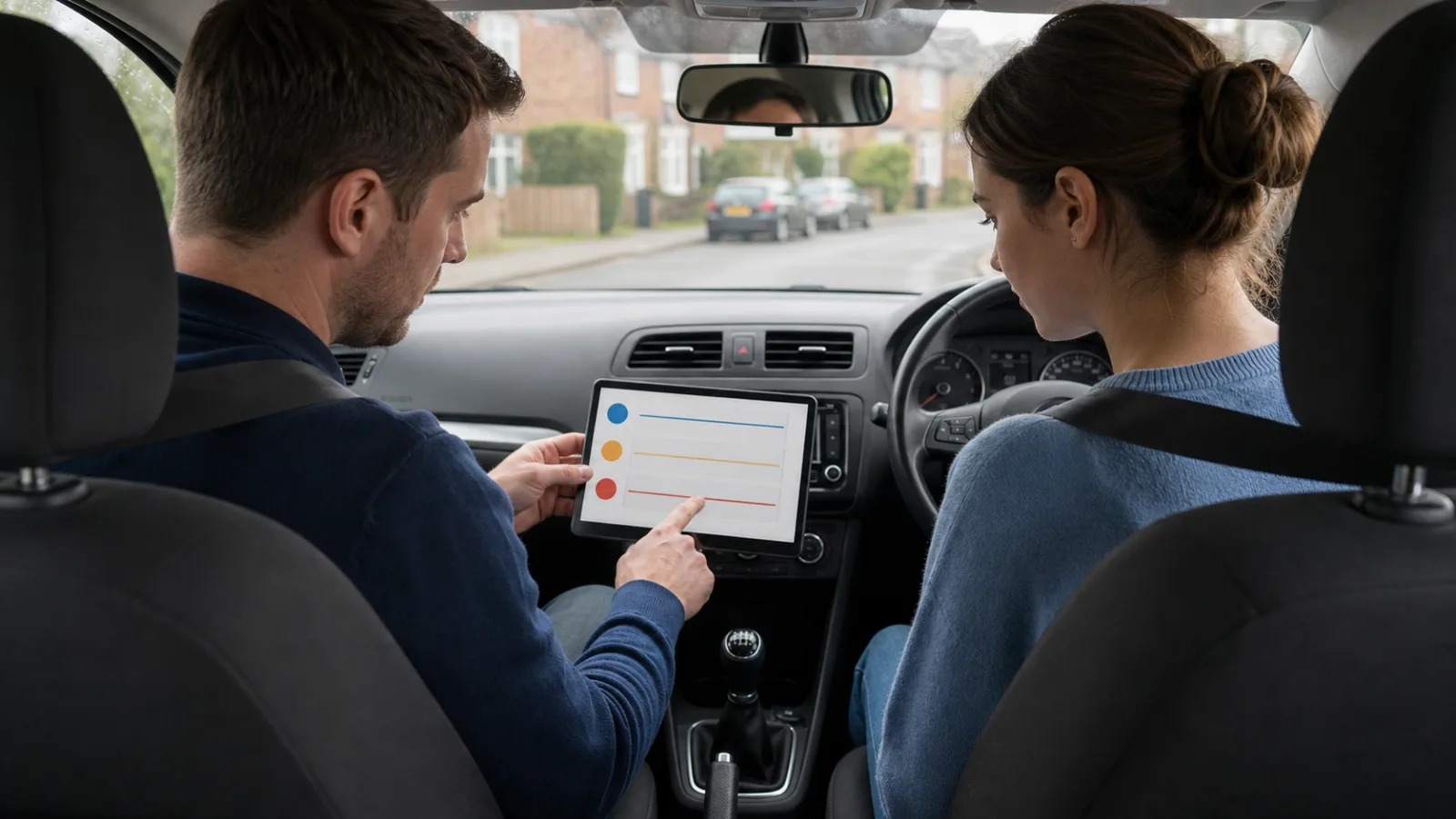
Last verified 3 August 2026 against the GOV.UK pages linked below. DVSA statistics are from the official June 2026 release.
You pass the UK driving test if you make 15 or fewer driving faults and no serious or dangerous faults: that is the entire standard, set out by the DVSA on GOV.UK. Every mistake you make during the test is sorted into one of three categories: a driving fault (the famous "minor"), a serious fault, or a dangerous fault. Sixteen driving faults fail you. One serious fault fails you. One dangerous fault fails you. Everything else about test marking (the examiner's report sheet, the debrief at the end, the myths about stalling and kerbs) flows from those three definitions, so this guide takes each one apart.
How many faults are you allowed on the driving test?
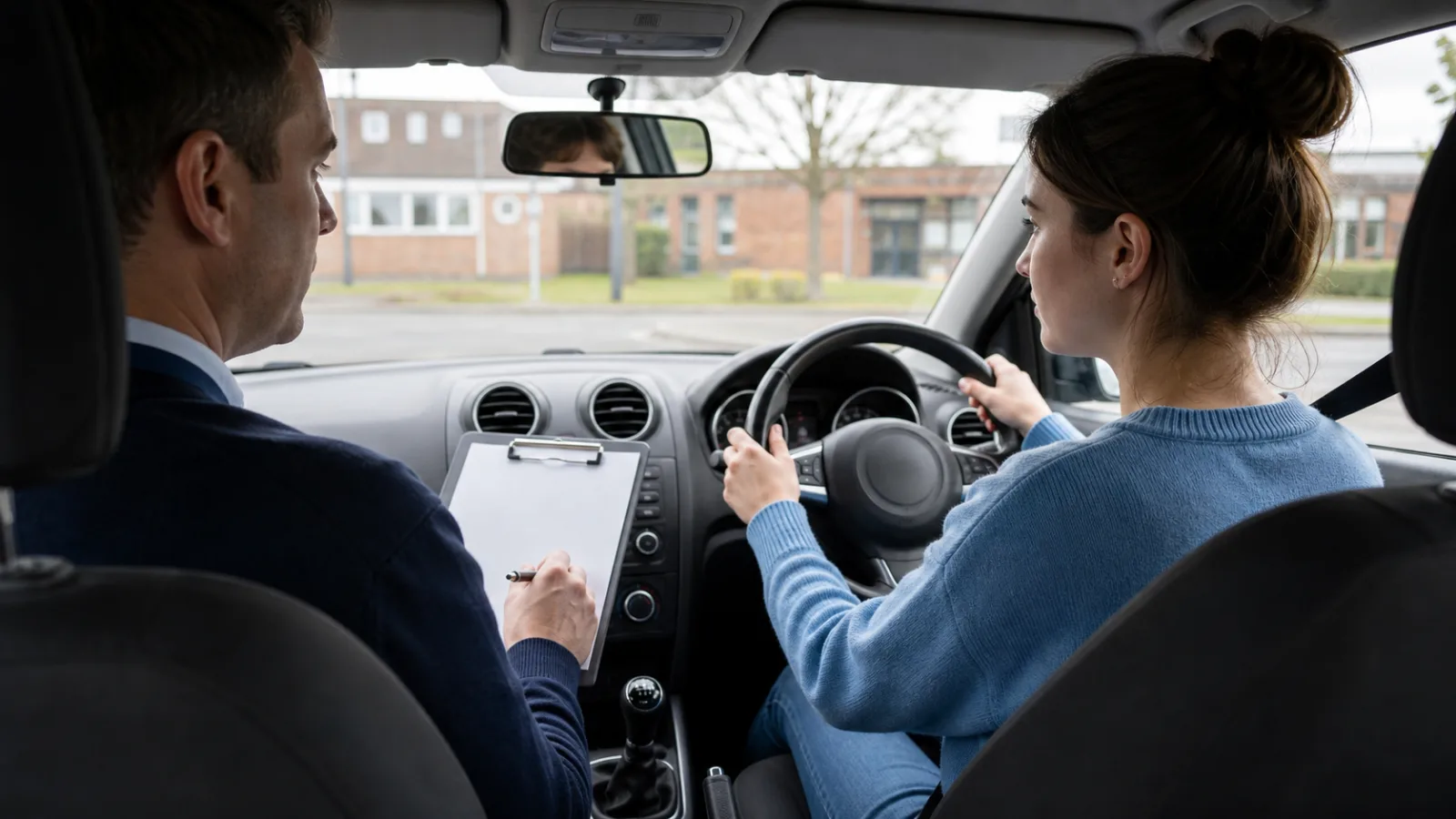
You are allowed up to 15 driving faults; the sixteenth driving fault, or a single serious or dangerous fault at any point, means a fail, as GOV.UK confirms. The examiner keeps a running record throughout the drive, gives you the result and feedback verbally at the end of the test, and you also receive the result by email.
The arithmetic is stricter than it sounds, because it is about severity, not volume. Candidate A picks up 14 driving faults scattered across mirrors, positioning and hesitation: an untidy drive, but a pass, with room to spare against the limit of 15. Candidate B makes only 2 faults in the whole test, but one of them is a serious fault for emerging from a junction without effective observation, a fail. You cannot "save up" a clean drive to offset one serious moment, and you cannot fail on driving faults alone until you reach 16 of them.
Those faults can be recorded against anything you do between the eyesight check and the moment you park at the end. Our walkthrough of what happens in the UK driving test covers that structure stage by stage.
What is the difference between a driving, serious and dangerous fault?
The difference is danger: a driving fault involves no danger, a serious fault involves potential danger, and a dangerous fault involves actual danger. These are not folk definitions. DVSA publishes them verbatim on its Ready to Pass campaign site:
"A driving fault is not potentially dangerous, but if you keep making the same fault, it could become a serious fault."
"A serious fault is something that has the potential to be dangerous."
"A dangerous fault involves actual danger to you, the examiner, the public or property."
In plain terms: a driving fault is an imperfection (a late mirror check, a slightly wide line on a turn, a moment of hesitation) that endangered nobody. A serious fault is a mistake that could have hurt someone if circumstances had been slightly different, even if, on the day, nothing bad happened. A dangerous fault means someone or something was actually put at risk, for example, another road user had to brake or swerve to avoid you.
How a repeated driving fault becomes a serious one
Notice the sting in the driving-fault definition: keep making the same fault and it "could become a serious fault". DVSA deliberately does not publish a fixed number at which this happens. It is the examiner's judgement about whether your mistakes are one-off slips or a habit. A single late mirror check is a slip. Failing to check your mirrors before almost every change of direction is a habit, and a habit of not knowing what is around your car has the potential to be dangerous. That is why the fault count on a test report matters less than the pattern behind it.
What does the examiner mark on the driving test report?
The examiner records faults against a standard set of competencies on the driving test report, the same categories for every candidate at every test centre, published in DVSA's guide to understanding your driving test result. Grouped by stage of the test, the report includes:
| Stage of the test | Report categories |
| Before you drive | Eyesight check; vehicle checks (the 'tell me' and 'show me' safety questions) |
| Manoeuvres and control | Controlled stop; reverse park; forward park; move off; ancillary controls |
| Core driving skills | Use of mirrors; signals; junctions; judgement; positioning; clearance to obstructions |
| Reading the road | Response to signs and signals; use of speed; following at a safe distance; progress; awareness and planning |
Any category can carry a driving, serious or dangerous fault. But the categories are not equally deadly: one of them ends more tests than any other.
What are the most common reasons for failing the driving test?
Not making effective observations at junctions is the single most common reason for failing. It sits at the top of DVSA's current ranking of why candidates fail, published through its Ready to Pass campaign. The full top ten, in order:
| Rank | Reason for failing |
| 1 | Not making effective observations at junctions |
| 2 | Not using mirrors correctly when changing direction |
| 3 | Not moving off safely |
| 4 | Incorrect positioning when turning right at junctions |
| 5 | Not having proper control of the steering |
| 6 | Not responding appropriately to traffic lights |
| 7 | Not responding correctly to traffic signs |
| 8 | Poor positioning on the road during normal driving |
| 9 | Not responding correctly to road markings |
| 10 | Not keeping control of the vehicle during reverse parking |
Look at that list closely and a theme emerges: most of the top ten are observation and response failures rather than raw car-control failures: six of them (observations at junctions, mirrors, moving off safely, traffic lights, traffic signs and road markings) are about seeing and reacting to what is around you. Candidates rarely fail because they cannot physically steer a car around a corner; they fail because they did not look, or did not act on what they saw.
The scale of failure is worth taking seriously. DVSA's own headline figure is that 48 out of every 100 driving tests were failed in Great Britain during June 2026, per the Ready to Pass campaign. Across the full 2025/26 year the national pass rate was 50.0% (1,000,043 passes from 1,998,621 tests) which is actually the highest in the recorded series going back to 2007/08 (DVSA data, published June 2026; full tables on our practical test pass rates page). Where you take the test shifts those odds dramatically: among centres with at least 1,000 tests in 2025/26, Wolverhampton passed 34.3% of candidates while Melton Mowbray passed 69.7%. You can compare every centre through our test centre directory.
How do examiners judge the same mistake as driving, serious or dangerous?
Context decides: examiners apply the three definitions to what actually happened around you: who was affected, and what would have happened if circumstances had been slightly different. The scenarios below show how the same action can land in all three categories. They are illustrative applications of the official definitions, not additional DVSA rules; on the day, the examiner judges the specific situation in front of them.
Emerging at a junction
You stop at a give-way line, look properly in both directions, and pull out a little cautiously, making the car behind ease off slightly: at worst, a driving fault for hesitation, nobody was endangered. Now replay it: you glance left but never properly check right before emerging. The road happened to be empty, so nothing occurred, but your observation was not effective, and emerging without knowing what is coming has the potential to be dangerous: a serious fault, and the country's number one fail reason. Replay it once more: you emerge into the path of an approaching car, which has to brake hard to avoid you. That is actual danger to the public. A dangerous fault, because this time the danger was real rather than hypothetical.
Touching the kerb
During the reverse park you brush the kerb lightly, stop, and calmly correct the position before finishing the manoeuvre: typically a driving fault, imperfect, controlled, harmless. Hit the kerb firmly, or ride up onto it, and carry on without correcting, and the examiner is now looking at a loss of control with the potential to be dangerous: serious. Mount the pavement where a pedestrian is walking and you have created actual danger to the public: dangerous. Same kerb, three verdicts: the difference is control and consequence, not the contact itself.
Stalling at traffic lights
The lights go green, you bring the clutch up too fast and stall; you secure the car, restart, check around you and move away: usually no worse than a driving fault. Stall three or four times at successive junctions, each restart more flustered than the last, and the pattern starts to show a control problem that could become serious, the repeated-fault escalation in DVSA's own definition. Stall halfway through a junction and restart in a panic, moving off without checking while other traffic is crossing, and you have moved into actual-danger territory. The stall is never really the fault; what you do next is.
A lot of this judgement is about reading environments you have seen before. Awkward junctions, blind exits and tight parking spots are features of specific roads, which is why many learners rehearse the driving test routes around their chosen centre before the day.
One thread runs through every scenario above and most of the top ten fail reasons: observation. Seeing what is developing around you early enough to act on it calmly. That is a trainable skill, and it is exactly what Drivings' free hazard perception practice clips drill: spotting a hazard as it starts to develop, again and again, until early scanning becomes reflex. If your theory test is still ahead of you, our free mock theory exams test that same judgement in the format the real test uses.
Your questions about driving test faults, answered
Will stalling fail my driving test?
No: a stall on its own is normally a driving fault, not a fail. What matters is your response: secure the car, restart, observe, move away. Stalling repeatedly, or restarting carelessly in a position that endangers other traffic, is what turns a stall into a serious or dangerous fault.
Is touching the kerb an automatic fail?
No: a light touch during a manoeuvre, corrected under control, is typically recorded as a driving fault. Mounting the kerb, hitting it hard, or making contact where pedestrians are put at risk is where it becomes serious or dangerous, because the examiner marks the danger involved, not the contact itself.
Are crossed hands on the steering wheel a fault?
No: there is no rule requiring push-pull steering, and crossing your hands is not itself marked. What the report assesses is whether you have proper control of the steering: if your technique leaves the car wandering, cutting corners or hitting kerbs, that control failure is the fault, and "not having proper control of the steering" ranks fifth on DVSA's list of fail reasons.
How many driving faults in the same category before it becomes serious?
DVSA does not publish a fixed number, and any figure you have heard is a rumour. The official definition says only that repeating the same driving fault "could become a serious fault". The escalation is the examiner's judgement about whether your mistakes form a potentially dangerous habit, not a mechanical count.
Can I ask the examiner which faults I got?
Yes: the examiner tells you the result verbally at the end of the test and explains the faults they recorded, and you also receive your result by email. Use the debrief: the categories on that report are the most precise practice plan you will ever get, whether you passed or not.
Do examiners have pass quotas?
No: every test is marked against the same national report categories and the same three fault definitions. Pass rates genuinely vary, from 34.3% at Wolverhampton to 69.7% at Melton Mowbray in 2025/26 (DVSA data, published June 2026), but that reflects different roads, junctions and candidates, not different standards or targets.
What happens if the examiner grabs the wheel or uses the brakes?
Your result will record that the examiner took action. Shown as "ETA" on the driving test report. The fault itself is still judged on the danger of the actual situation, not on the intervention: in practice, a moment that forces the examiner to grab the wheel or use the dual controls will be marked as a serious or dangerous fault, so the test is failed, but it is that fault which fails you, not the intervention as such. Examiners step in, verbally or physically, only to keep everyone safe; if it happens, treat the debrief as a map of exactly what to fix before your next attempt.
Can I move my test date if I don't feel ready?
Yes: DVSA lets you change your appointment free of charge as long as you give at least 10 full working days' notice. Given that nearly half of all tests end in a fail, moving a date you are not ready for is often the cheaper decision; the notice rules and recent changes are covered in our guide to the 2026 driving test booking rule changes.