Lauren Weatherby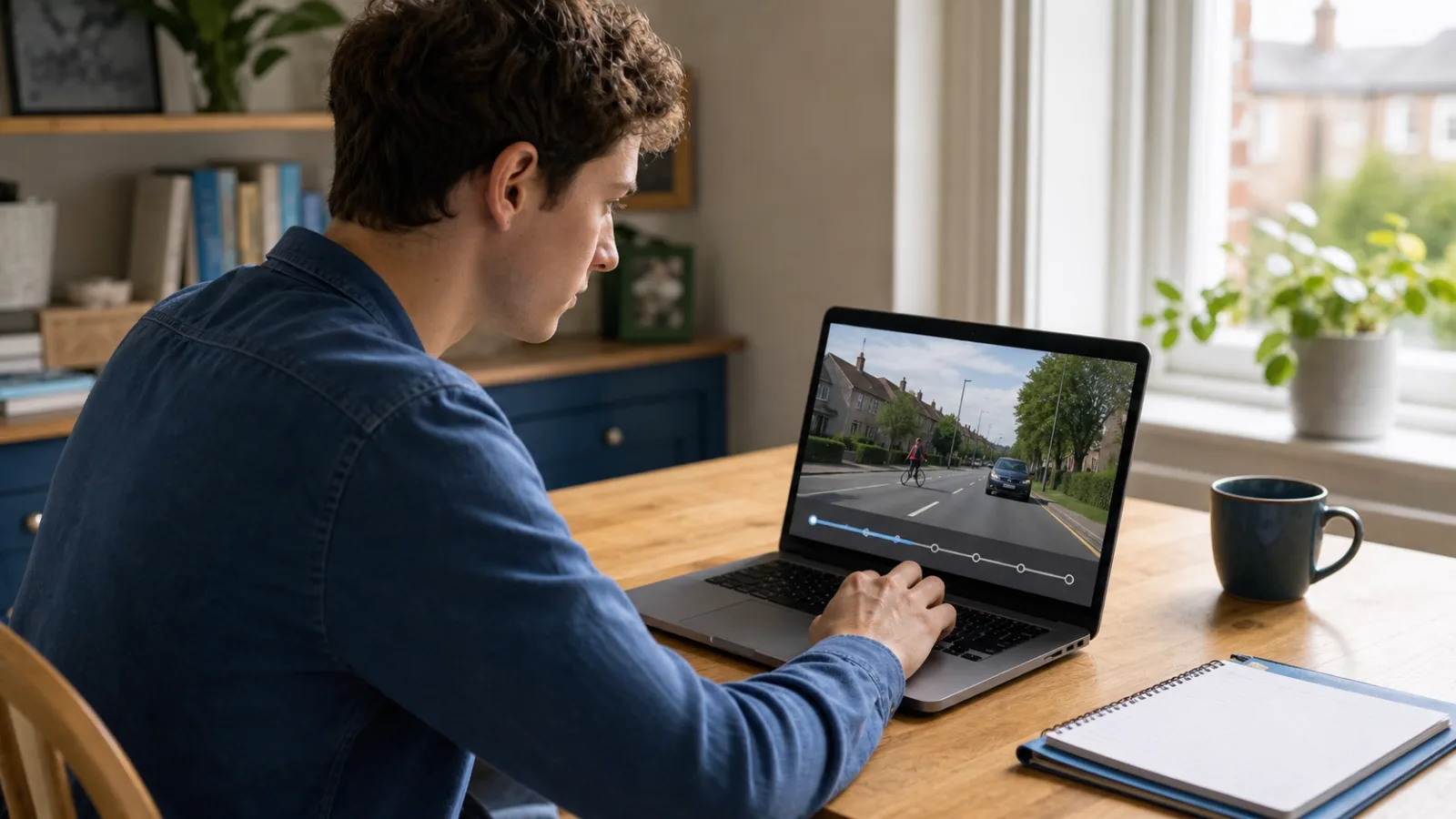
Last verified 3 August 2026 against the GOV.UK pages linked below. DVSA statistics are from the official June 2026 release.
The hazard perception test is scored like this: you watch 14 video clips containing 15 developing hazards, each hazard is worth up to 5 points, the maximum score is 75, and you pass with 44 or more. Every clip contains at least one developing hazard, and exactly one clip contains two. That is where the fifteenth hazard comes from. Your score on each hazard depends entirely on when you click: respond the moment the hazard starts to develop and you take the full 5 points; respond later and the same hazard pays 4, 3, 2, 1 and finally nothing as it plays out.
That sliding window is the whole game, and it is the part learners most often misunderstand. This guide explains exactly how the click window works, what separates a developing hazard from a merely potential one, what genuinely triggers the feared "clicking in a pattern" rule, and a repeatable method for scoring well on every clip.
How is the hazard perception test scored?
You earn 0 to 5 points per developing hazard depending on how early in its scoring window you click, and you need 44 of the 75 available points to pass. Three further rules shape how you should play it, all confirmed on GOV.UK's hazard perception page:
- You do not lose points for wrong clicks. Clicking at something that never turns into a hazard costs you nothing at all.
- You get one attempt at each clip. There is no review screen and no going back to a clip you fumbled.
- Continuous or patterned clicking scores zero. Not for the whole test, for that clip.
Notice the asymmetry those rules create. Under-clicking is expensive: a missed hazard forfeits up to 5 points with no way to recover them. Honest over-clicking is free. Every scoring incentive in this test points the same way: when in doubt, click.
What counts as a developing hazard?
A developing hazard is something that would make you, the driver, change speed or direction, not something that merely might. That distinction between might and would is the entire test. A car parked on the left with its wheels straight is a potential hazard: it could pull out, but right now you would drive past it without adjusting anything. The instant it starts moving off into your path, it becomes a developing hazard, because now you would have to slow down or steer around it. The same logic applies to a pedestrian waiting at the kerb (potential) versus stepping into the road (developing), or a cyclist riding steadily ahead (potential) versus swerving out around a drain cover (developing).
The test only pays for developments. Clips are deliberately full of potential hazards (parked vans, side roads, children on pavements, oncoming lorries), and most of them never do anything. Your job is to monitor all of them and click the moment one of them crosses the line from "might affect me" to "is affecting me".
How does the 5-4-3-2-1 click window work?
Each developing hazard has a scoring window that opens the instant the hazard starts to develop, and the earlier inside that window your click lands, the more of the 5 available points you score, stepping down to zero as the situation plays out. Here is one worked scenario, a pedestrian emerging between parked cars, showing how the same hazard pays differently depending on when you respond:
| Moment in the clip | What you can see | Click now and you score |
| Early in the clip | A pedestrian stands on the pavement between two parked cars, facing the road | 0 (a potential hazard; the window has not opened, but the click costs nothing |
| The window opens | They glance at the traffic and step towards the kerb edge | 5) the hazard has started to develop and you caught it immediately |
| Shortly after | Their first foot lands in the road, still tight to the parked cars | 4 |
| Mid-window | They are walking out into your lane; you would be coming off the accelerator | 3 |
| Late in the window | They are well into your path; you would already be braking firmly | 2, falling to 1 |
| The window closes | They have crossed, or your car has slowed and the moment has passed | 0. The hazard has fully developed and the points are gone |
Two lessons sit in that table. First, the gap between 5 points and 2 points is a couple of footsteps. Hesitation is the main tax the test collects. Second, the click before the window opened scored nothing and cost nothing, which is why you should never hold a click back while deliberating whether something "really counts" yet.
Now run the pass-mark arithmetic, because it is genuinely reassuring. You need 44 out of 75, which works out at just under 3 points per hazard on average. Fifteen mid-window clicks, every one of them a slightly-late 3, gives you 45 and a pass. So does catching nine hazards perfectly at 5 points each and missing six entirely. You do not need fifteen perfect reactions; you need to see most hazards reasonably early and avoid whole-clip blanks.
Why early, but not random, clicking maximises your score
The highest-scoring strategy follows directly from the rules: click the moment a potential hazard turns into a developing one, and since wrong clicks are free, click on the suspicion as well. A habit worth building is the double response: one click when you first judge that something is about to develop, a second click the moment it visibly does. If your first click was premature, it scored zero harmlessly; if your judgement was right, one of those two clicks landed at the very top of the window. What you must not do is substitute rhythm for judgement. A stream of clicks fired to blanket the clip is the one behaviour the test is built to detect.
What actually triggers the "clicking in a pattern" rule?
Sustained clicking that bears no relationship to what is happening on screen, not a handful of genuine responses. The rule itself, verbatim from GOV.UK, is a single sentence:
You will not score anything if you click continuously or in a pattern.
Two things about this rule are widely misread. First, the penalty is per clip: patterned clicking zeroes that clip, it does not fail your whole test, though throwing away 5 or 10 points on one clip can still sink you when the pass mark is 44. Second, look at what the words actually describe, clicking continuously, or in a pattern. That means non-stop clicking, or a steady metronome beat maintained regardless of the video. A cluster of honest clicks in a busy street scene (even five or six across one clip, including a couple of premature ones) is a response to the footage, not a pattern. This rule catches candidates trying to carpet the scoring window without watching; it should not frighten anyone who is genuinely responding to the video.
One attempt, no replays, and the clip with two hazards
You cannot review or change your responses, and each clip runs exactly once. This is a sharp contrast with the multiple-choice part, where the video-based questions let you replay the clip as many times as you like and you can flag questions to revisit. Hazard perception is live: whatever you clicked as the clip played is your answer.
The two-hazard clip matters more than it sounds. One clip in your set of 14 contains two developing hazards worth 5 points each. GOV.UK does not say which clip it is, so treat every clip as the one. The practical consequence: never relax after scoring on a hazard. Keep scanning to the final frame of every clip, because on one of them a second window will open, and on the other thirteen, the habit costs you nothing.
A scan-and-click method you can repeat on every clip
The method that transfers best is commentary observation: silently naming what you see, then clicking the moment anything you have named starts to act. It works like this:
- Scan in thirds. Sweep far (junctions, crossings, brows of hills), middle (side roads, parked vehicles, cyclists) and near (pedestrians at the kerb, car doors), then repeat, continuously, rather than staring at the centre of the screen.
- Name every potential. "Parked van. School sign. Junction on the right." Naming keeps each one on your watchlist, so movement registers instantly instead of surprising you.
- Click on change, not existence. The van existing is not a hazard; the van's wheels turning is. Movement, brake lights, a head-check, a wobble. Change is your trigger.
- Click again if it escalates. A suspicion click followed by a development click brackets the top of the window, and the spare click is free.
- Reset instantly after a miss. The clip does not pause for your frustration, and the next hazard, possibly in the same clip, pays just as much.
This is the same observe-and-respond habit that examiners later want to see on the practical drive, which is why clip practice tends to improve real-road awareness too. For the multiple-choice side of your revision, our theory test tips cover how to study the question bank efficiently.
The mistakes that cost prepared candidates a pass
The failures that hurt most are repeatable errors, not bad eyesight or slow reflexes:
- Clicking on the potential, then switching off. The classic score-killer. You spot the parked car, click, and mentally file the hazard as "done", but the window was not open, so that click scored zero, and when the car actually pulls out you watch it happen without clicking again.
- Freezing after a miss. One late click turns into three, because you are replaying the mistake instead of scanning. At up to 5 points per hazard, one miss is survivable; a rattled ninety seconds is not.
- Pattern-clicking anxiety. Fear of the anti-cheat rule makes some candidates ration themselves to one click per clip. That converts a free action into a hoarded one and hands back easy points.
- Watching like a passenger. If you view the clip as television, hazards are just things that happen. Watch as the driver, asking "what would make me brake?", and developments announce themselves.
Where hazard perception sits in the full theory test
Hazard perception is the second half of a single sitting: first come 50 multiple-choice questions with a pass mark of 43, then a break of up to 3 minutes, then the 14 clips. The full structure is in our guide to the theory test pass mark and format. You must pass both parts in the same sitting: fail either one and you book and take the whole test again, after waiting at least 3 working days and paying the £23 fee again. The stakes are not theoretical: just 44.8% of the 2,924,430 car theory tests taken in Great Britain in 2025/26 ended in a pass (DVSA data, published June 2026). The year-by-year, age and gender breakdowns are on our theory test pass rates page. The encouraging part is that hazard perception is usually the quicker half to fix. The question bank takes weeks of revision; the click window is a skill you can sharpen in a few focused sessions once you understand how it pays.
Understanding the window and feeling it are different things, though. You need repetitions to learn where 5 points lives. Drivings has hazard perception practice clips scored the same way as the real test, so you can see exactly where in each window your clicks are landing and train them earlier, and you can pair the clips with a free mock theory exam to rehearse the full two-part sitting before you book the real one.
Your questions about hazard perception scoring, answered
Does clicking too much fail the hazard perception test?
No. Only clicking "continuously or in a pattern" scores zero, and that penalty applies to the individual clip, not your whole test. Multiple genuine clicks driven by what is happening on screen are safe. The rule exists to stop people blanketing the clip without watching it.
Do I lose points for clicking at the wrong time?
No. GOV.UK states plainly that you do not lose points if you click and get it wrong. A wrong click scores nothing and costs nothing, which is why holding clicks back "to be safe" is the opposite of safe.
What counts as a developing hazard?
Anything that would cause you to change speed or direction, right now. A hazard that merely might affect you (a parked car, a waiting pedestrian, an approaching junction) is only potential, and clicking on it scores nothing until it starts to act.
How many points per hazard do I need to pass?
An average of just under 3 points per hazard: the pass mark is 44 out of 75 across 15 hazards. Consistent mid-window clicks pass comfortably, and even nine perfect 5-point responses alone reach 45. Remember that one clip carries two hazards, so a clip can be worth up to 10 points.
Can I retake just the hazard perception part?
No. If you fail either part, you must book and take the full test again, both parts, after at least 3 working days, even if you scored well on the part you passed.
Can I replay a clip or change a response?
No. You get one attempt at each hazard perception clip, with no review and no going back. Only the video clip in the multiple-choice section can be replayed.
How do people fail hazard perception while passing the multiple-choice?
Because the two parts reward different preparation. The multiple-choice part can be revised from a question bank; the click window is a timing skill, and candidates who never practised scored clips tend to click on hazards they saw perfectly well, just late enough in the window to score 1 or 2 points instead of 5. The fix is scored clip practice, not more reading.
Is there a break before the hazard perception part starts?
Yes: you can take a break of up to 3 minutes after the multiple-choice questions before the clips begin. Use it. A short reset before fourteen clips of sustained scanning is worth having.